
Co-creation is Innovation Without the Ick
Urban Technology at University of Michigan week 290
This semester we have, for the first time, a poster full of all the lectures that we’re hosting in the UT Studio and in the building. I’ve been dreaming of this for a while, so it’s gratifying to finally have a collection of inspiring people who all said yes to visiting us and sharing their work and thinking with the students. Such a simple thing, the lecture series, and yet it feels like this is the thing that anoints us—finally!—as a real community of thinkers, question-askers, bull$&%@-callers. In other words, people who care.
When Jack Bernard, junior in UT, came up to me after a recent lecture by Mariama N'Diaye, Director of Atlanta’s Innovation Team in City Hall, and asked if he could write the newsletter, I was glad to invite him as a guest author. Continue below for Jack’s reflection on our visit from Mariama and her unique take on civic innovation.
💬 Hello! This is the newsletter of the Urban Technology program at University of Michigan, in which we explore the ways that data, connectivity, computation, and automation are being harnessed to nurture and improve urban life. If you’re new here, try this 90 sec. explainer video.
🪴 Growing an Ethic of Care in Local Government
Mariama N’Diaye is the director of the Innovation Team at the City of Atlanta, and she stopped by to share with us what she’s learned from institutionalizing collaborative and care-based design in governance and what “civic innovation” really means to her. N’Diaye’s background combines a rare set of perspectives, having studied urban planning and business at MIT and then doing a thesis on civic design. All of this combines into a passion for deeply rethinking how government could work to serve its people. Stay with me to learn how the City of Atlanta is working to deeply consider outside perspectives and embracing civic design as a mindset to create a more ethical, responsible and competent approach to governance.
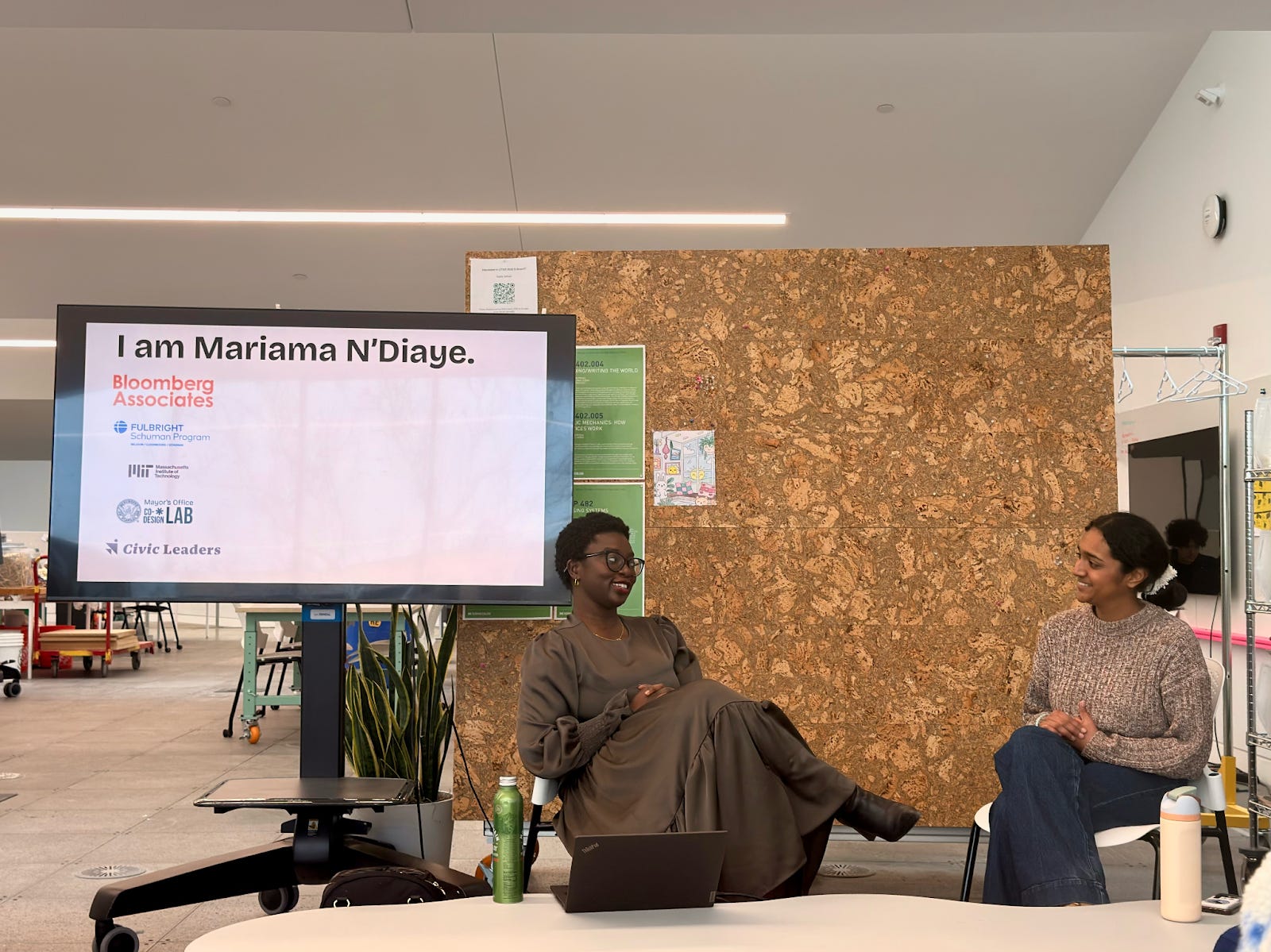
Even before her guest lecture started, one of N’Diaye’s guiding principles became apparent just from observing how she introduced herself, interacted with others, and met everyone with a smile and a handshake. Putting “relationships over requests” is not just something she preaches, but what she embodies and practices, even here on campus. Any business student could tell you that your network is your net-worth, but in a civic design context, relationships are the raw material of co-creation, whether that is of products, policies, or outcomes in the public realm. This is not just to build buy-in or to check a community engagement box, but to create space for people to feel seen and heard throughout the design process. In this way, integrating care into civic work is not just the prioritization of a moral value, but can be the foundation for innovation in a more just and pluralistic society.
Here at the University of Michigan we have an entire research lab dedicated to understanding barriers to delivering effective public services, still searching for many answers in 2026. Despite this topic taking up some academics’ entire dissertations, improving the way the government works also seems to be a topic that everyone—from the clerk at the grocery store to the billionaire CEO of a failing social media platform—has an opinion on. Each person seems convinced that their idea of a seemingly simple solution A) has not already been thought of or tried, and B) is comprehensive enough to solve these complex problems entirely. “If they just did X, then Y would never be an issue!” Are these ‘armchair governance’ kinds of comments pure criticism? N’Diaye helps us reframe the question and instead asks what value can be taken when interpreting criticism as a way of showing up, and speaking up as an act of care. Seen from this perspective, frustrated citizens represent an untapped source of energy that can contribute to building and shaping the work of government—if that government is ready to listen, engage, and co-create.
As a prominent scholar of political theory and care-based ethics, Professor Joan C. Tronto presents five “ethical qualities of care” to outline what it takes to understand and empathize with those you are working with. Responsibility, responsiveness, attentiveness, competence, communication and plurality are all values N’Diaye puts forth in her work, and uses in a civic context to understand how to best meet the needs of the community in the outcomes her team creates. A care-based approach is critical to civic work due to government’s scale. The term “innovation” is a piece of coded language often associated with picking up, turning and shaking out the current situation to envision new ways of doing things and disrupting old norms. But even if a system is broken, inefficient or in need of change, people take comfort in what they know and often attach value to the status quo. N’Diaye seeks to understand such community values before pushing for change. The result she seeks is one where outcomes are in-touch with the needs of a neighborhood or community of people.
This doesn’t mean N’Diaye’s team works at a snail’s pace, though. In an age of rampant techno-solutionism (increasingly in government contexts), prioritizing listening and understanding over immediate disruption leads to far better outcomes for all parties involved. To create a space for marginalized voices to be heard and understood is to create a place where solutions emerge that uplift and empower, not drive deeper an existing divide or disconnect. A more meaningful solution that aligns with community values might take longer to produce, but will require less remediation in the long-term by virtue of early investment in trust-building.
Leading with care means understanding where people are at, and building tools and solutions that meet them there to move the needle forward, not jump past them entirely. For example, a flashy new website or digital product will do nothing to help solve an issue if the vast majority of the user base finds it unhelpful or offensive. Instead of disruption, N’Diaye sees civic innovation as “moving forward together,” and understanding: “Who has tried to work on this? What is the history? Who can we travel with to try to fix this meaningful issue?”
While good user experience of public-facing tools and services is important to consider in civic contexts, N’Diaye also flipped the perspective and discussed how technological tools can be used to improve internal operations, help civil servants better understand their problem space, and build solutions faster. Instead of treating technological development as a silver bullet to fix all issues facing the public sector, she framed technology as a tool to help with the real problem solving—performing engagement, defining issues, and building capacity.
How can we deploy a stronger communications strategy that leverages digital resources to bridge information gaps within the community? How can we develop a new data standard to unify strategy and operations among different city departments? How can we use digital tools to better understand stakeholders, their needs and conditions? How might we use technology to back up claims, hold people accountable, and push development forward at an accelerated pace? These are some of the questions N’Diaye and her team seek to answer. None can be answered sitting alone at a computer.
It’s easy to hire a full stack developer to vibe-code a new intake form that uses a trending typeface and pastel colors, but N’Diaye’s definition of civic technology is not interested in band-aid solutions to individual problems. Design-based civic innovation requires knowledge and understanding, or “Context over Disruption” as N’Diaye put it in her presentation. To gain this critical context, teams must first build the infrastructure and tools needed to understand their people and the problems facing them. This provides a framework to shift from a reactionary and top-down model of public services, to a proactive and uplifting approach to civic tech.
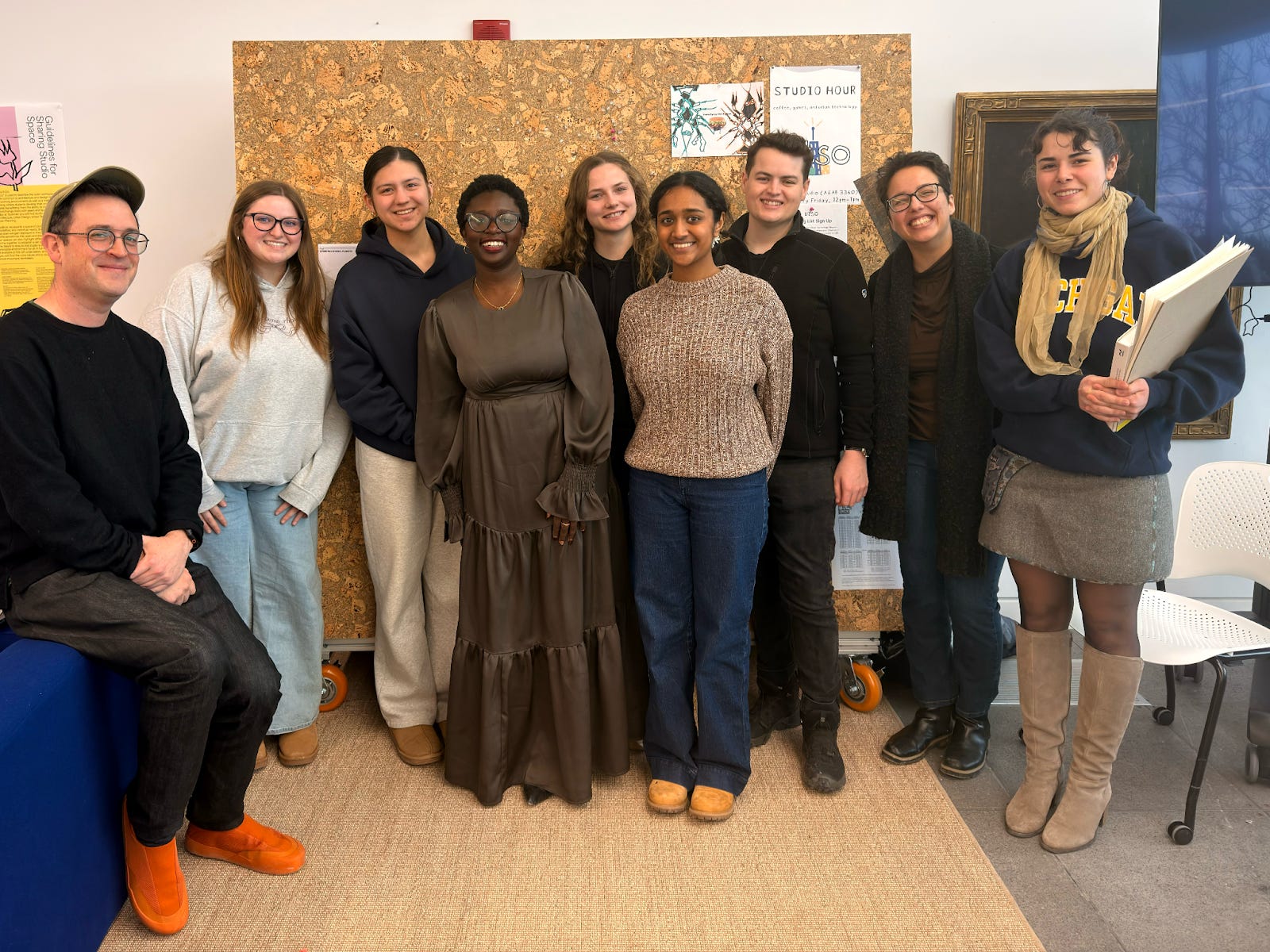
If there was one main idea I walked away with from N’Diaye’s lecture, it was that “innovation” is a complicated, multifaceted, and sensitive topic that requires a lot more work than just the code behind an app. There are obviously lots of problems in government, just like there are lots of problems in any organization, but the solution-making process has much more intimate and delicate stakes in the public sector. Innovation here is not just for innovation’s sake… to understand “government efficiency” we must first understand the role of government, and its goals in serving the general populace.
The premise of “co-design” is innovation with, not just for the people to be served by any solutions created. Building relationships and integrating community into design processes is the future of civic innovation as N’Diaye described it. Government doesn’t get to choose which people to serve and which to ignore as outside the “target demographic.” All people use services in unique ways with individual needs. The biggest idea of Mariama’s talk was her suggestion that the most important capability of the public sector is to bring individuals with professional and lived experiences together to understand common needs and create reliable solutions.
These weeks: Career fair. Leadership trek nuts and bolts. More friendly faces in the studio for talks. And a random 60° day in the mix.
 | A guest post by
|